
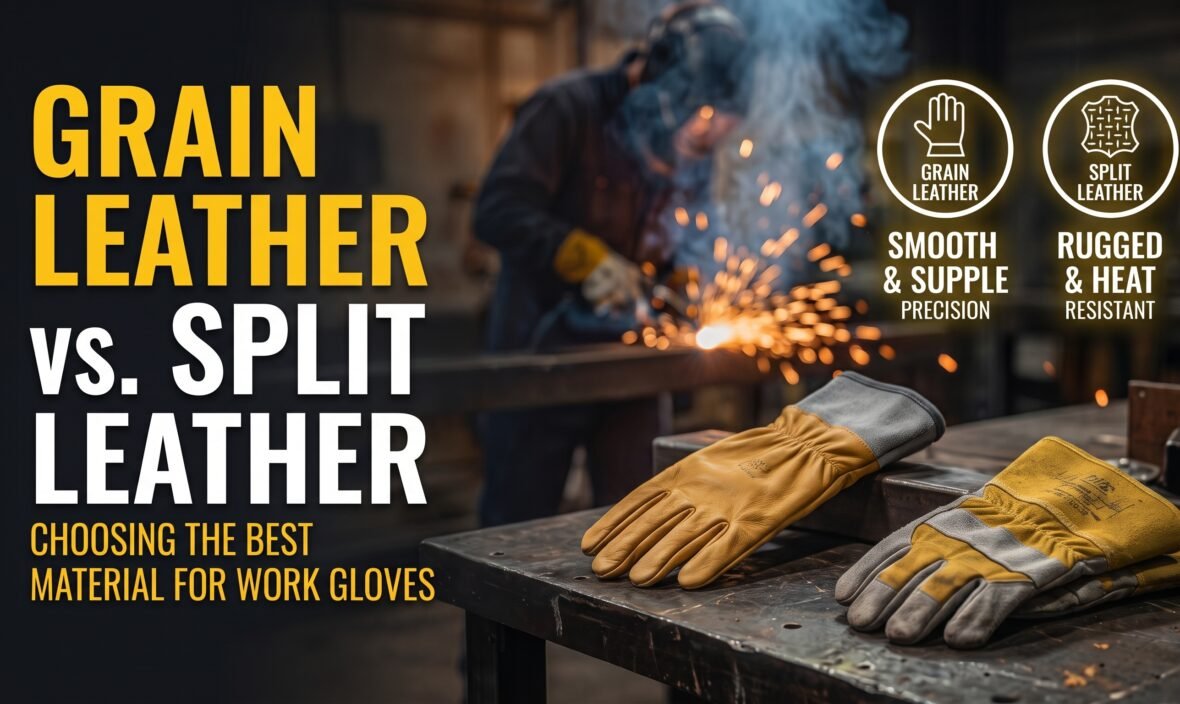
When sourcing leather work gloves for an industrial workforce, the terminology can often be confusing. Two of the most common terms you will encounter in PPE specifications are Grain Leather and Split Leather. While both come from the same animal hide, their physical properties, durability, and ideal applications are completely different.
Selecting the wrong type of leather can lead to reduced operational efficiency, faster glove degradation, and compromised safety. Here is a complete guide to understanding the differences between grain and split leather so you can source the right protection for your specific industrial needs.
1. What is Grain Leather? (Dexterity and Precision)
Leather hides are typically too thick to be used in their natural state, so they are split into layers. Grain leather (often called top-grain) is the smooth, outermost layer of the animal’s skin. Because it contains the natural epidermis, it is incredibly dense and tightly woven.
Key Characteristics of Grain Leather:
- Smooth Surface: It naturally repels water, oil, and dirt much better than other leathers.
- High Dexterity: Grain leather is typically thinner and more supple, allowing for excellent tactile sensitivity and finger control.
- Longevity: The dense fiber structure provides excellent tensile strength, meaning it won’t easily stretch out of shape.
Best Suited For: Precision tasks, TIG welding, driving, operating heavy machinery, material assembly, and tasks where workers need maximum flexibility and grip.
2. What is Split Leather? (Toughness and Heat Resistance)
Once the top grain is removed, the bottom layer of the hide is what remains. This is known as Split Leather. It has a rougher, fibrous, suede-like texture on both sides. While it lacks the natural water resistance of grain leather, it compensates with extreme ruggedness.
Key Characteristics of Split Leather:
- High Abrasion Resistance: The fibrous texture makes it incredibly tough against cuts, scrapes, and rough surfaces.
- Superior Heat Resistance: Split leather is thicker and naturally more insulating, making it the top choice for high-heat environments.
- Cost-Effective: It is generally more economical to produce than top-grain leather while providing maximum heavy-duty protection.
Best Suited For: Heavy-duty fabrication, MIG and Stick (MMA) welding, handling rough lumber, metal stamping, and abrasive construction environments.
3. Grain vs. Split Leather: A Quick Comparison
| Feature | Grain Leather | Split Leather |
| Texture | Smooth, naturally repels moisture | Rough, suede-like, highly fibrous |
| Dexterity & Feel | High (Great for precision work) | Low to Medium (Stiff but highly protective) |
| Heat & Spark Resistance | Moderate | Exceptional |
| Abrasion Resistance | Good | Excellent |
| Ideal Welding Type | TIG Welding | MIG & Heavy Arc Welding |
4. Compliance and Global Safety Standards
Whether you are sourcing grain leather gloves for assembly or split leather gauntlets for welding, ensuring the gloves meet international safety standards is critical for workplace compliance in the UK, Europe, and Australia:
- EN 388: The European and UK standard for mechanical risks (assessing abrasion, cut, tear, and puncture resistance).
- EN 407: The standard for thermal risks, which is particularly important when evaluating split leather welding gloves.
- AS/NZS 2161: The Australian/New Zealand standard for occupational protective gloves, ensuring your workforce is legally protected on-site.
Conclusion: Which One Should You Choose?
The choice between grain and split leather ultimately comes down to the hazard your workers face. If the job requires precision, oil resistance, and a high degree of touch sensitivity, Grain Leather is the clear winner. However, if your workers are dealing with extreme heat, sparks, and abrasive, heavy materials, Split Leather will provide the rugged defense they need.
Sourcing high-quality, fully certified industrial work gloves for your market? Contact our exports team today to discuss premium leather PPE solutions tailored to your industry standards.



Leave a comment